Ben Heck did it again. He made a C64 laptop using original hardware. This is the same guy who did the Xbox 360 laptop… which is proof that an Xbox 360 “slim” is possible.

Ben Heck did it again. He made a C64 laptop using original hardware. This is the same guy who did the Xbox 360 laptop… which is proof that an Xbox 360 “slim” is possible.
A video demonstrates playing Left 4 Dead and Crysis on a cell phone using OTOY, a video streaming technology similar to OnLive. Details about the video is provided by this article by TechCrunch. Breathtaking tech if it can reach the market.
One game at Funspot that I never saw before was Donkey Kong II. From my limited searching, looks like this is a homebrew hack of Donkey Kong done a few years back. Just need to swap out a chip or two to convert a vanilla DK machine into a DKII machine. Took me awhile, but I finally found the roms and an emulator so you can play the game at home. I managed to watch the tail end of the record DK2 game, 380+k points. Other records that were broke at Funspot XI can be found in this thread.
Some of the Penny Arcade folk redid Adventure into a 16-bit like game. An original score is added, along with some handy front-end menus. Available for download. Judging by the vids, looks really well done.

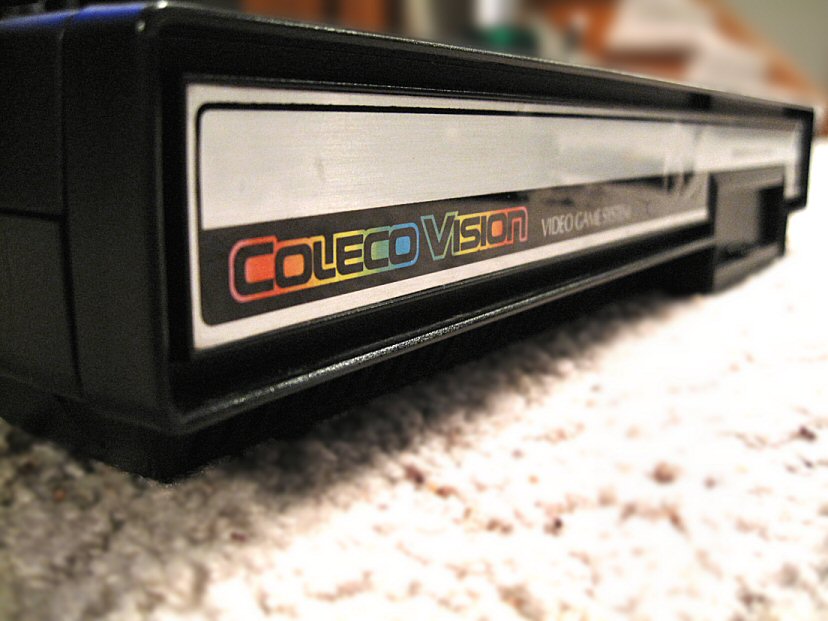 As many of you know, I recently acquired a ColecoVision. It is the last of the early consoles that I’ve wanted to collect. I know, you can’t believe that. But it’s likely true. I managed to snag one off of CraigsList for next to nothing… a mere $20. It came with three games and two controllers. The person listing it claimed ignorance about it’s faulty behavior and mentioned nonchalantly that it, “Just needed a good cleaning.”
After getting the unit setup, I was able to make it work. However, it was very dirty and the power switch seemed a bit flakey. I decided to take the whole thing apart, clean it from top to bottom and spray some contact cleaner on the switch. I put it all back together and to my absolute shock–the power button was worse! Now I could hardly slide it back and forth (see FABombjoy’s post here). I removed the cover. The switch slid back and forth freely. Apparently the design of this model is sub-par as the screws that hold the unit together–though hand tightened–were preventing movement on the switch!
After fidgeting with the unit repeatedly, I started looking around on the interwebs and found this:
“The most common CV deck failure I’ve seen (about 6 out of 10 old decks) is power switch failure. It’s noted in the CV FAQ, but their repair tip for it is not very good (doesn’t work for me). Basically, what happens is the lubricant in the power switch dries out over the years, resulting in poor contact- which means insufficient power to the unit. You can buy a DPDT switch for it from ratshack, and that has worked for me. Thing is, soldering out the old switch, and soldering in a new one is the easy part. The HARD part is making the new (and slightly different height) switch play nice with the exterior glamour cap (the black slider you actually touch on the outside of the unit). I’ve successfully done it a number of times, but it involves a file, and a dremel, and some trial and error.”
Later I also stumbled on this:
“The standard ColecoVision power switch is a DPDT (double pole, double throw) switch. Meaning that its basically 2 switches that can be connected in one of two ways. Technically one of the throws for each pole is not used. So while the standard switch has 6 contacts, only 4 are used. The center contacts are the live contacts. The one nearest the left edge of the board is the +12V line and the inner one is the +5V line. When the switch is is slid to the rear (ON position), the center (live contacts) make contact via the internal contact slides to the rear contacts which then send the +12V and +5V to where they need to go and power on the PCB. When the switch is slid forward (OFF position) the center (live contacts) make contact via the internal contact slides to the front contacts which aren’t connected to anything. Coleco could have used a DPST switch, which is all that is needed, but DPDT switches are more standard and probably easier and cheaper to find. And by the by the -5V from the power supply is always on, which is why the ON/OFF switch is only a double pole not a triple pole.”
Those two entries (and vast other Google Searching) led me to a fix and an eventual case mod. 😉